SOLIDWORKS Simulation
Bring real-world performance into your design process with SOLIDWORKS Simulation—a powerful, fully integrated analysis solution that lets you validate, optimise, and innovate without the cost and delay of physical prototyping.
This October, we've got great deals on Simulation and Simulation Training

Simulation Solutions
Turn ideas into Proven Designs
Discover what’s new across SOLIDWORKS Simulation, SOLIDWORKS Plastics, and SOLIDWORKS Flow Simulation in 2027.
This release helps engineers build more realistic studies, prepare models faster, evaluate results more clearly, and reduce repetitive work across structural, plastics, and fluid-flow analysis. In this video, we explore improved nonlinear analysis for bolt preloads and spring connectors, clearer structural result reporting, and new tools for summing reaction forces and evaluating stresses at bonded interfaces.
You’ll also see more flexible Plastics study storage, persistent multi-point result probes, built-in Reynolds number results for cooling analysis, automatic gap sealing for internal flow studies, one-click rebuilding of linked Flow Simulation sub-projects, and much more across FEA, CFD, and injection molding analysis types in 2027.
Why SOLIDWORKS Simulation?

Design with confidence
Identify potential failures early by analysing stress, strain, and deformation under real-world loads.

Accelerate time to market
Reduce reliance on costly prototypes and physical testing by validating designs virtually.

Optimise performance
Explore multiple design scenarios to improve strength, durability, and efficiency.

Fully integrated workflow
Work directly inside your SOLIDWORKS CAD environment—no data translation, no workflow disruption.
Structural simulation
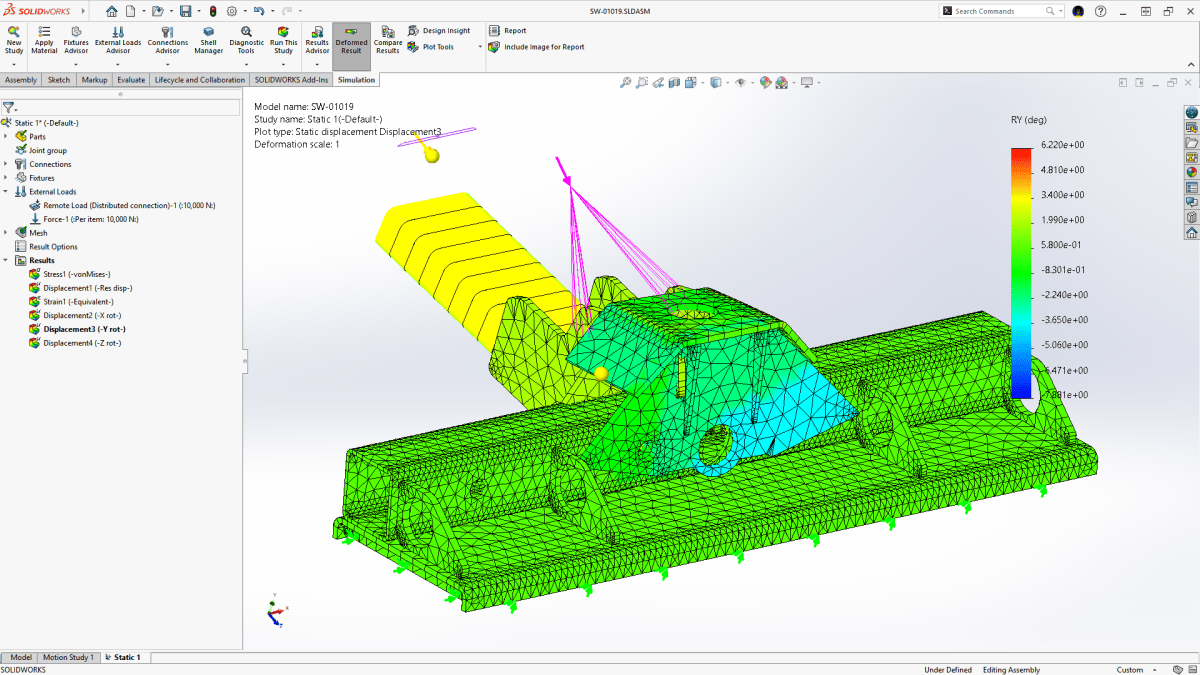
Structural simulation using the Finite Element Method (FEM) and related technologies, offers a deep understanding of how products, assemblies, and processes respond to real-world conditions, including varying loads and temperature

Electromagnetic simulation
Investigate the electromagnetic properties of components or whole systems efficiently. Electromagnetic (EM) systems often pose multiscale challenges, such as wide frequency ranges and electrically large structures with fine detail.
Computational fluid dynamics simulation
Engineer products with precise real-world performance predictions delivered quickly.